Back to Projects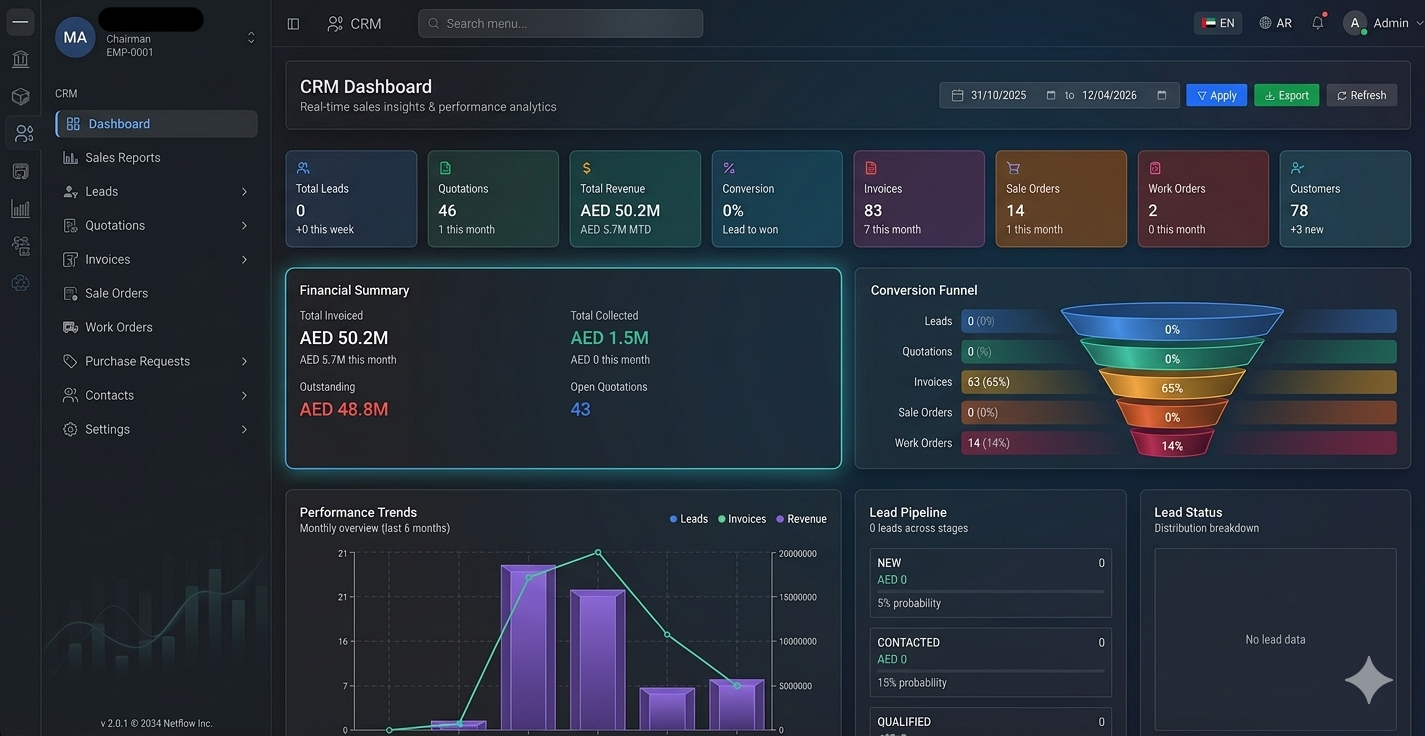
Netfo Car Dealership Multi Tenant ERP
Web AppNetfo is a comprehensive, multi-tenant Software-as-a-Service Enterprise Resource Planning platform engineered specifically for the automotive dealership industry. It manages every aspect of vehicle retail operations — from the moment a lead walks in, through the sales pipeline, vehicle procurement and inventory, financial transactions, employee management, logistics and delivery, all the way to after-sales service and customer retention. The platform is built to support dealership groups operating multiple showrooms and service centers from a single, centralized system with branch-level data isolation and performance tracking.
The architecture operates on two distinct layers. The first is a platform administration workspace accessible only to Netfo's own team, where platform super administrators, subscription managers, support agents, and analysts manage the entire SaaS ecosystem. This workspace provides tenant management for creating and configuring dealership companies, subscription plan management with tiered pricing and feature toggles, module enablement per company, platform-wide billing and invoice generation, analytics dashboards tracking revenue and tenant growth, system maintenance tools for health checks and database management, and integration management for API keys and webhook configurations.
The second layer is the tenant-facing ERP, where each dealership company gets its own isolated environment with access to configurable modules based on their subscription plan.
Customer Relationship Management (CRM)
The CRM module is the commercial engine of the platform, managing the entire customer journey from first contact to final delivery. Lead management supports the full lifecycle — capturing leads from multiple sources, automatic lead distribution through a configurable ADSL (Automatic Distribution by Salesperson Load) system, and tracking leads through stages including live, contacted, qualified, and lost. Each lead maintains a complete timeline of interactions, vehicle interests, follow-up history, and salesperson assignment records. Lead source tracking enables dealerships to measure which marketing channels produce the highest quality prospects.
When a lead progresses, the system generates quotations with itemized pricing, currency support, agent commission encoding, and configurable validity periods. Quotations flow into sale orders, which track line items, end-user information, required document checklists, and approval workflows. Sale orders convert into invoices with full payment tracking — advance payments, verified customer payments, and remaining balance calculations with amounts displayed both numerically and in words. The invoicing system supports multiple currencies and generates professional PDF documents with customizable templates, QR code verification, and digital signatures.
Work orders are created from invoices to manage the physical delivery process, capturing logistics details including loading and discharge ports, incoterm specifications, shipping modes, bill of lading types, forwarder and carrier assignments, driver assignments, delivery ETAs, and real-time location tracking. The CRM also includes a comprehensive contacts module for managing customer profiles, agent relationships, and contact persons with full address management.
Stock and Inventory Management
The stock module provides complete vehicle lifecycle management from acquisition to sale. Each vehicle record captures detailed specifications, features, pricing with full price history tracking, multiple images, and associated documents such as registration papers and inspection certificates. The system supports brand, model, and variant hierarchies with configurable spec sheet templates for standardized vehicle documentation.
Vehicle inspection is deeply integrated, with configurable checklists, defect tracking and categorization, inspection history, and pre-delivery inspection (PDI) records. Inventory management spans multiple locations with support for vehicle reservations, inter-location transfers with full movement tracking, and allocation management. The viewing module tracks customer vehicle viewings and showroom activity.
Stock reporting is comprehensive, offering inventory summaries, aging analysis to identify slow-moving stock, movement reports, location-based inventory views, brand and model analysis, vehicle valuation reports, transfer history, and supplier-wise inventory breakdowns.
Finance and Accounting
The finance module delivers a complete double-entry accounting system tailored to automotive dealership needs. It starts with a fully configurable chart of accounts organized into hierarchical account groups, supporting the specific account structures dealerships require for tracking vehicle sales revenue, cost of goods sold per unit, trade-in valuations, and warranty reserves.
Journal entry management supports standard entries, contra transactions, and general payments with multi-currency support. Bank management includes bank account setup, transaction recording, and a bank reconciliation engine that matches bank statements against system transactions. The sales and receipts module tracks customer payments, generates sale invoices, maintains payment histories, and produces customer statements. On the payables side, the system manages supplier payments, purchase invoices, expense entries, and supplier statements.
Payroll integration connects with the HR module for salary disbursement tracking and pay slip management. The loans and advances module handles employee loan management, advance payment tracking, and installment scheduling with automatic payroll deductions.
Financial reporting generates trial balances, profit and loss statements, balance sheets, cash flow statements, and tax reports — giving dealership management real-time visibility into their financial position across all branches.
Procurement and Demand Management
The procurement module manages the complete purchasing lifecycle for both vehicle stock and operational products. Purchase requests can be initiated for vehicles or general products, each flowing through configurable approval workflows before advancing to the next stage. The system maintains a supplier directory with contact information, contract management, and performance tracking metrics.
Request for Quotation (RFQ) management enables dealerships to solicit and compare quotes from multiple suppliers, with structured quotation tracking and comparison tools. Approved requests convert into purchase orders with detailed line items, supplier assignment, and status tracking through pending, confirmed, and received stages.
Goods receipt is managed through Goods Receipt Notes (GRN) with integrated quality inspection. The quality control system supports configurable inspection checklists, scored assessments, defect tracking, and photo evidence capture. Three-way matching validates purchase orders against goods receipts and supplier invoices before payment processing, ensuring financial accuracy and preventing discrepancies.
Purchase returns are tracked with reason codes, refund processing, and complete return history. The procurement analytics dashboard provides supplier performance reports, cost analysis, and delivery performance metrics to support strategic purchasing decisions. Supplier contracts manage long-term agreements including rate terms, validity periods, and renewal tracking.
Human Resources
The HR module manages the complete employee lifecycle from recruitment to separation. Employee profiles capture personal information, contract details, employment type, position and department assignments, shift schedules, and policy associations. The system supports multiple employment types and position hierarchies.
Attendance management provides daily tracking with configurable attendance policies, overtime calculation and tracking, monthly summary reports, missing attendance resolution workflows, and approval processes. Leave management includes configurable leave types with balance tracking, request and approval workflows, leave history, and policy enforcement to prevent unauthorized absences.
The payroll system is built around configurable salary components (basic pay, allowances, deductions, benefits) organized into salary groups. Payroll generation processes all active employees, calculating gross and net pay based on attendance, leave, loan deductions, and configured components. The system generates individual pay slips and manages salary disbursement tracking.
Employee loans module handles loan applications, approval workflows, installment scheduling, repayment tracking, and automatic salary deductions. Performance management includes employee awards and appreciation tracking, performance appraisals, and skill assessments.
Onboarding workflows manage new hire processes with configurable checklists, document collection, training module assignments, and orientation scheduling. Offboarding handles employee resignations, terminations, exit interviews, knowledge handover processes, company asset recovery, and final settlement calculations.
The meetings module supports scheduling, attendance tracking, and meeting summary documentation with calendar views. HR settings allow comprehensive configuration of holiday calendars, work shifts, leave types, positions, departments, salary components, and awards.
Logistics and Transportation
The logistics module manages the physical movement of vehicles from supplier to dealership and from dealership to customer. Shipment management groups multiple vehicles into shipments with milestone tracking, supporting both inbound (supplier to dealer) and outbound (dealer to customer) flows. Each shipment tracks status, assigned items, and key milestones from creation to delivery.
Carrier management maintains a directory of transport companies with contract management, rate agreements, performance tracking, and insurance documentation. Fleet management covers the dealership's own transport vehicles, driver profiles with licensing and certification tracking, vehicle-driver assignments, fleet maintenance records, and fuel consumption tracking.
Route planning supports multi-stop route creation with waypoint management, transport schedule coordination, and pickup request handling. Real-time delivery tracking provides GPS-based location updates with milestone-based progress reporting.
The shipping documents module generates and manages Bills of Lading, commercial invoices, packing lists, delivery advice documents for customs, and 10+ additional document types required for vehicle transport. The receiving operations module manages dock scheduling, inbound receiving activities, and receiving inspections.
Freight cost tracking allocates transport costs per vehicle, while the damage claims module manages multi-point inspections, claim workflows, and resolution tracking for vehicles damaged during transport.
Marketing and Campaigns
The marketing module provides campaign management with creation, templating, and performance analytics. Campaigns track associated leads and conversion metrics to measure return on marketing investment. Follow-up management includes scheduling with calendar views and configurable automation rules for systematic customer engagement. Marketing contacts support list management, audience segmentation, and bulk operations for targeted outreach.
Documentation and Knowledge Management
The documentation module serves as the dealership's internal knowledge base and document management system. Template management provides a drag-and-drop builder for creating document templates with variables and placeholders, approval workflows, usage tracking, and analytics. The knowledge base module houses FAQs, articles, guides, and searchable reference materials organized by category.
Standard operating procedures and policy documentation support versioning and change tracking with rollback capability. Training materials management includes module creation, schedule management, employee assignments, and progress tracking. The centralized document library provides versioned storage with access control, categorization, and search functionality.
IT and Cybersecurity
The IT and cybersecurity module manages the dealership's technology infrastructure and security posture. IT operations include a helpdesk ticketing system with issue tracking, resolution workflows, and SLA management. IT asset tracking monitors hardware and software across the organization.
Security and compliance features cover policy management, compliance tracking, audit logging, risk assessment, and security incident tracking. Identity and access management provides multi-factor authentication (2FA), password policy enforcement, session management, device trust management, and user access provisioning.
Network security configuration manages firewall rules, VPN settings, and network monitoring. Email security covers filtering rules, spam management, encryption, and audit logging. Endpoint security handles antivirus management, patch management, and vulnerability tracking. Performance monitoring provides system metrics, resource utilization tracking, and bottleneck identification. Built-in tools include a watermark image generator and vehicle specification sheet creator.
Administration and Platform Configuration
The administration module provides the foundation for all dealership operations. Company management handles profile information, business hours, and system-wide settings. Branch management supports creating and configuring multiple locations with independent settings and the ability for users to switch between branches.
User and role management implements a sophisticated permission system where policies (roles) are created with granular permission matrices. Permissions follow a module.entity.action pattern (for example, crm.invoice.create or stock.vehicle.edit) with scope controls — users can be granted access to all records, only their own records, or only records within their branch. Advanced policy features include field-level restrictions that hide or make read-only specific form fields, section-level restrictions, time-based conditions, cross-module conditions, resource state conditions, policy composition and inheritance, and a permission testing suite.
Workflow management provides a configurable pipeline and approval engine. Administrators define pipelines with stages, status transition rules, and approval requirements. The workflow engine enforces these rules across all modules, maintaining complete entity stage history for audit purposes.
Company branding allows dealerships to customize their visual identity with multiple logo variants (horizontal, vertical, dark, light, favicon), brand colors, and layout preferences that cascade through PDF documents, emails, and the platform interface.
Cross-Cutting Platform Features
The AI integration provides generative AI capabilities with chat-based assistance, tool calling for automation, AI-powered analytics, and export functionality supporting multiple AI providers. Real-time messaging enables internal team communication with chat rooms, message history, read receipts, and participant management.
The notification system delivers in-app notifications with history tracking and configurable settings. Activity logging maintains a comprehensive audit trail of all user actions across every module. File management provides centralized upload, download, attachment, and versioning services used by all modules.
Universal search enables finding records across all modules from a single search interface. The follow-up system provides cross-module follow-up scheduling with configurable rules and calendar views. The verification service generates QR codes for document verification, enabling recipients to validate the authenticity of invoices and quotations.
PDF generation supports two template systems — a classic template with traditional boxed layouts optimized for specific dealerships, and a modern template with a two-column design featuring a gray sidebar, branded accent colors, and clean typography. Both templates support company logos, brand colors, and customizable content sections.
Technical Architecture
The frontend is built with Next.js using React, styled with Tailwind CSS and Shadcn/ui components, with Redux for state management and Iconify for icons. The backend runs on NestJS with PostgreSQL as the database, Prisma as the ORM, and JWT-based authentication with refresh token rotation. The system manages over 150 database models across all modules with over 500 API endpoints.
The multi-tenant architecture ensures complete data isolation between companies while sharing the same application infrastructure. File storage supports both local and Amazon S3 cloud storage with automatic CORS proxy handling. The platform is deployed as a cloud-hosted solution accessible at custom domains with configurable base paths for enterprise deployments.
Tech Stack
Nest.jsPostgresNext.jsRedux ToolkitRedisTailwindcssShadcn UIPrisma ORM
Related Projects
IntraPrism SaaS AI ERP
A modular, AI-powered SaaS ERP platform with microservices architecture — unifying HRM, Finance, CRM, Approvals, Drive, Mail, and a Customer Portal into one seamless, scalable system with real-time cross-service intelligence.
Covvo - Insurance Management System
Full-stack insurance claims platform connecting companies with adjusters. Features an 11-gate smart assignment engine, compliance management, real-time chat, wallet & membership system, state licensing, and a React Native mobile app for field adjusters.
Flaxen ERP - Paint Manufacturing
Enterprise resource planning system for the paint manufacturing industry. Covers formulation, production & filling, inventory, sales, procurement, accounting, HRM, and project management with multi-company, multi-branch support and real-time dashboards.